System and Organisation Controls
System and Organisation Controls (SOC) reports are independent assurance reports designed to evaluate how effectively an organisation manages risk, security, availability, and internal controls. Developed by the American Institute of Certified Public Accountants (AICPA), SOC reports have become a global benchmark for trust and assurance, particularly for service providers handling sensitive data or critical business processes.
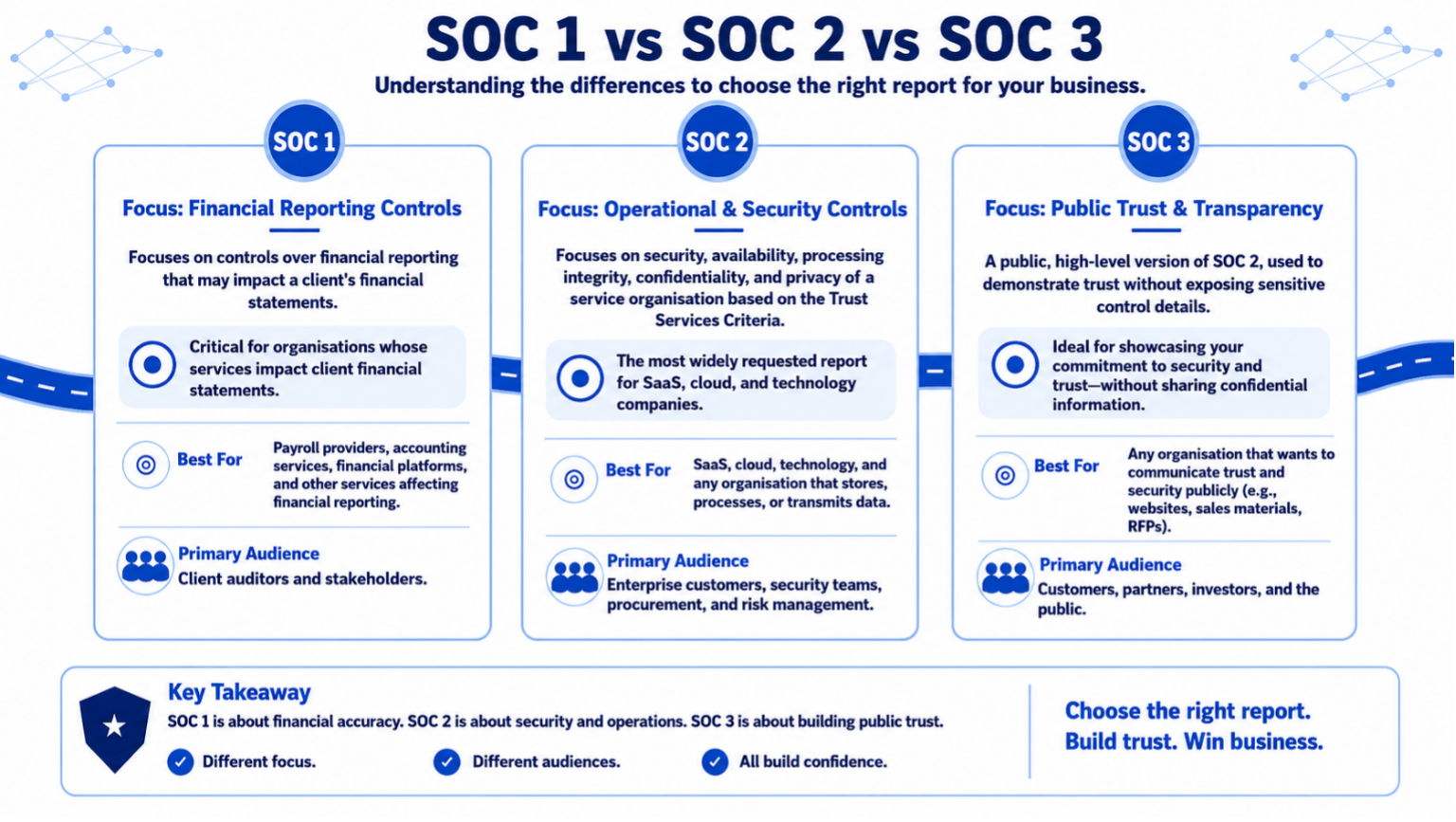
SOC reports serve different assurance and communication purposes. SOC 1 addresses controls relevant to user entities’ internal control over financial reporting, while AICPA SOC 2 examinations address controls relevant to security, availability, processing integrity, confidentiality or privacy. SOC 2 engagements use applicable Trust Services Criteria and may result in a SOC 2 Type 1 or SOC 2 Type 2 Report, depending on the engagement. SOC 3 covers similar subject matter to SOC 2 but provides a general-use report with less detailed information about the underlying controls.
SOC reporting has evolved from a “nice-to-have” to a commercial necessity:
· Enterprise clients increasingly require SOC 2 before signing contracts
· Procurement teams use SOC reports to assess third-party risk
· Investors and regulators expect demonstrable governance maturity
· It accelerates market entry into regulated sectors
Without SOC compliance, organisations often face delayed sales cycles, lost deals, and increased scrutiny.
SOC 2 Compliance can help service organisations respond more effectively to customer security reviews, procurement requirements and third-party risk assessments. Preparing for a SOC 2 examination also encourages organisations to establish clear governance, documented processes, evidence collection and appropriate SOC 2 Security Controls. For organisations providing technology, cloud, SaaS or data-driven services, a SOC 2 report can provide customers and other specified users with independent assurance information about relevant controls. The appropriate scope depends on the organisation’s services, systems, commitments, risks and applicable Trust Services Criteria.
Kelmac applies a pragmatic, audit-focused methodology designed to minimise disruption while accelerating readiness.
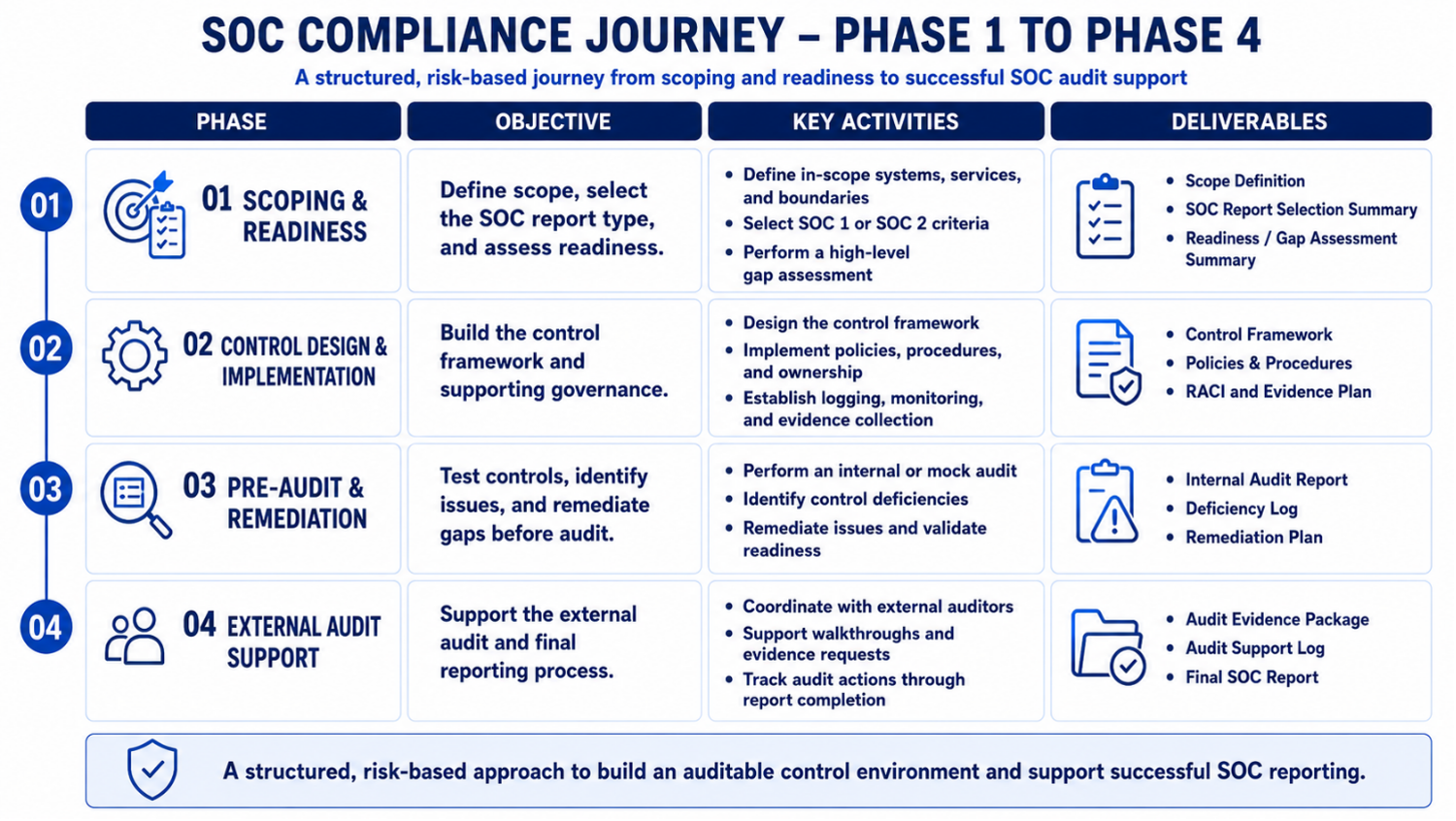
Effective SOC 2 audit preparation begins before the independent examination. Kelmac Group® can support organisations through SOC 2 Compliance Consulting, including scope definition, a SOC 2 Readiness Assessment, control review, documentation and evidence preparation. A SOC 2 Gap Assessment can identify areas where existing controls, policies or evidence require attention against the applicable Trust Services Criteria. Remediation can then focus on identified gaps before the organisation engages the independent practitioner responsible for the SOC 2 examination and report. This separation maintains a clear distinction between consulting support and independent attestation.
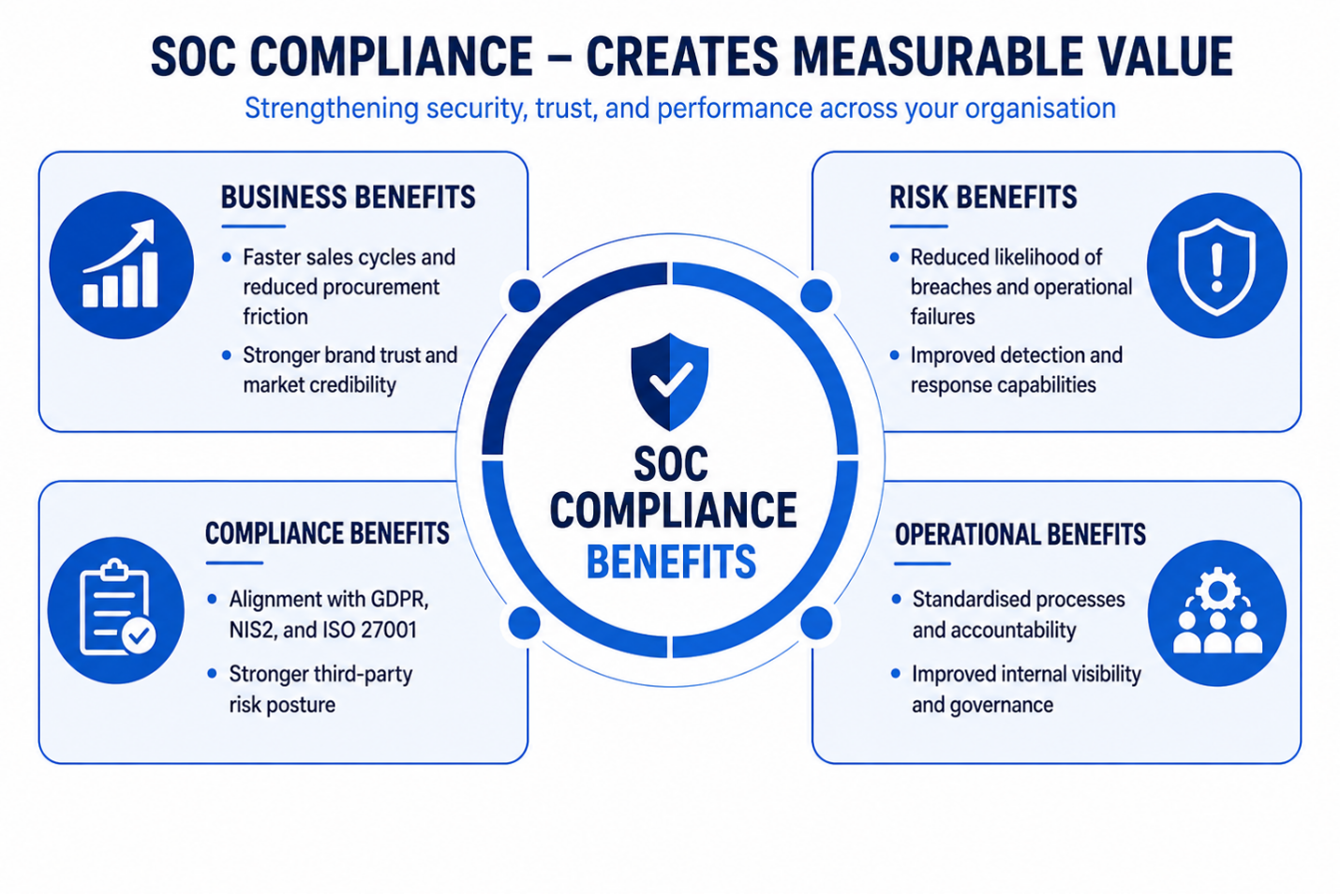
A structured SOC 2 Compliance programme can strengthen the way an organisation manages security risks, control ownership, documentation and evidence. Working with an experienced SOC 2 Consultant can help organisations interpret readiness requirements, assess existing controls and prepare for independent examination without confusing consulting with attestation. Appropriate SOC 2 Security Controls can also support wider governance and risk-management objectives where requirements overlap with other frameworks. For organisations pursuing SOC 2 Compliance India or supporting international customers, readiness should be based on the organisation’s systems, services, contractual commitments and applicable Trust Services Criteria.
Frequently Asked Questions
SOC 1 focuses on financial reporting controls, while SOC 2 focuses on security, availability, and data protection.
SOC 3 is a public-facing report used to demonstrate trust without exposing sensitive details.
Typically, 3-6 months for readiness and Type 1. Type 2 requires an additional monitoring period of 6–12 months.
It depends on your services. Financial service providers may need SOC 1, while SaaS and tech companies typically require SOC 2.
It includes assessment of policies, controls, systems, and evidence demonstrates that controls are effectively implemented.
No, but ISO 27001 alignment can support NIS2 compliance. A maturity assessment helps identify how your current controls align with both.
Organisations should begin assessing their readiness immediately, as regulatory expectations and supervisory activities are increasing across the EU.
SOC 1 reports address controls at a service organisation that are relevant to user entities’ internal control over financial reporting. SOC 2 reports address controls relevant to security, availability, processing integrity, confidentiality or privacy using applicable AICPA Trust Services Criteria. SOC 3 covers similar subject matter to SOC 2 but is designed as a general-use report and contains less detailed information about the controls and testing. The appropriate report depends on the organisation, its services and the information its intended users require.
A SOC 2 Type 1 engagement addresses the design of controls at a specified point in time, whereas SOC 2 Type 2 addresses the design and operating effectiveness of controls over a specified period. For organisations preparing for a SOC 2 Type 2 Report, readiness therefore involves more than documenting controls; relevant controls need to operate and generate appropriate evidence during the examination period. A SOC 2 Readiness Assessment can help identify gaps and preparation priorities before the independent examination begins.
SOC 2 is not itself an Indian law or a general statutory certification requirement for organisations operating in India. It is an assurance reporting framework developed by the AICPA. Organisations may pursue SOC 2 Compliance in India because customers, contractual arrangements, procurement processes or third-party risk programmes request a SOC 2 report. The need for SOC 2 should therefore be assessed separately from compliance with applicable Indian cybersecurity, privacy and sector-specific legal requirements. Organisations should determine which regulatory and contractual obligations apply to their particular activities.
A SOC 2 Readiness Assessment evaluates how prepared an organisation is for an independent SOC 2 examination. It can consider scope, systems, applicable Trust Services Criteria, policies, procedures, control design, responsibilities and available evidence. A SOC 2 Gap Assessment can then identify deficiencies or areas requiring further development. Readiness work does not produce a SOC 2 attestation report; rather, it helps the organisation prepare its control environment and supporting evidence before engaging the independent practitioner responsible for the SOC 2 examination.
A SOC 2 Consultant supports an organisation in preparing its control environment for a SOC 2 examination. Depending on the agreed scope, SOC 2 Compliance Consulting may include readiness assessment, scope definition, control mapping, policy and procedure development, gap analysis, remediation planning and SOC 2 audit preparation. The consultant’s role should remain distinct from the independent practitioner conducting the SOC 2 examination. Kelmac Group® can describe its specific consulting deliverables based on the agreed engagement rather than presenting consulting support as certification or independent attestation.