
NIST Cybersecurity Framework
The NIST Cybersecurity Framework is a globally recognised standard for managing and reducing cybersecurity risk. It provides a structured approach to identifying, protecting, detecting, responding to, and recovering from cyber threats. Developed by the National Institute of Standards and Technology, the framework is widely adopted across industries, including financial services, healthcare, and critical infrastructure.
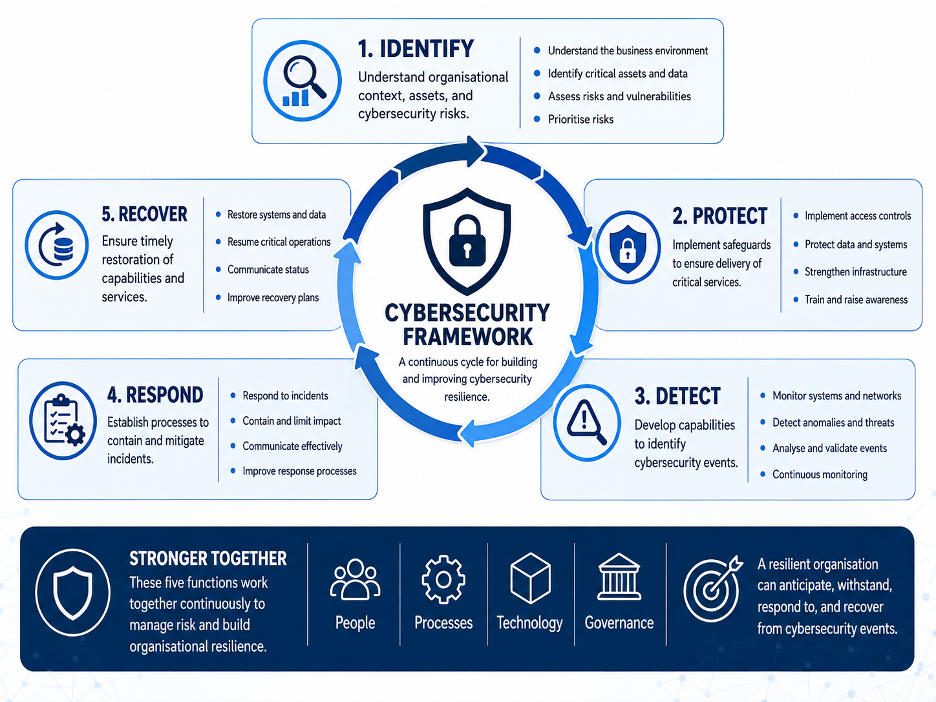
The NIST CSF is built around five core functions:
· Identify: Understand organisational context, assets, and cybersecurity risks.
· Protect: Implement safeguards to ensure delivery of critical services.
· Detect: Develop capabilities to identify cybersecurity events.
· Respond: Establish processes to contain and mitigate incidents.
· Recover: Ensure timely restoration of capabilities and services.
These functions enable organisations to build a comprehensive and scalable cybersecurity programme.
The current NIST Cybersecurity Framework provides a flexible, outcome-based structure for managing cybersecurity risk across organisations of different sizes, sectors and maturity levels. Under CSF 2.0, the Core contains six interconnected Functions: Govern, Identify, Protect, Detect, Respond and Recover. These Functions should be considered together rather than treated simply as sequential implementation stages. Organisations can use the Framework alongside Profiles and Implementation Tiers to understand their current cybersecurity posture, define target outcomes and communicate cybersecurity priorities across technical, operational and leadership teams.
A NIST CSF 2.0 Assessment provides a structured view of how an organisation currently manages cybersecurity risk and where improvement may be required. CSF 2.0 is organised around six Functions: Govern, Identify, Protect, Detect, Respond and Recover, supported by Categories and Subcategories that describe cybersecurity outcomes. Kelmac Group® can support organisations in reviewing their current cybersecurity practices, identifying gaps and establishing improvement priorities aligned with business risk. The assessment can also inform Current and Target Profiles, helping organisations define practical priorities rather than treating the Framework as a prescriptive compliance checklist.
· Structured Risk Management
· Adopt a proven framework to manage cyber risk systematically.
· Improved Governance
· Align cybersecurity with business objectives and risk appetite.
· Regulatory Alignment
· Support compliance with regulations such as GDPR, NIS2, and DORA.
· Enhanced Resilience
· Strengthen your ability to prevent and respond to cyber incidents.
· Stakeholder Confidence
· Demonstrate a mature and recognised approach to cybersecurity.
Implementing the NIST CSF can provide a common structure for connecting cybersecurity activities with organisational risk, governance and business priorities. Effective NIST CSF Implementation starts with understanding the organisation’s current state, business context, cybersecurity risks and desired outcomes. CSF 2.0 can be used by organisations regardless of size, sector or maturity and does not prescribe a single method for achieving its outcomes. This flexibility enables organisations to prioritise improvements according to risk, resources and operational requirements while creating a clearer basis for communicating cybersecurity priorities to management and other stakeholders.
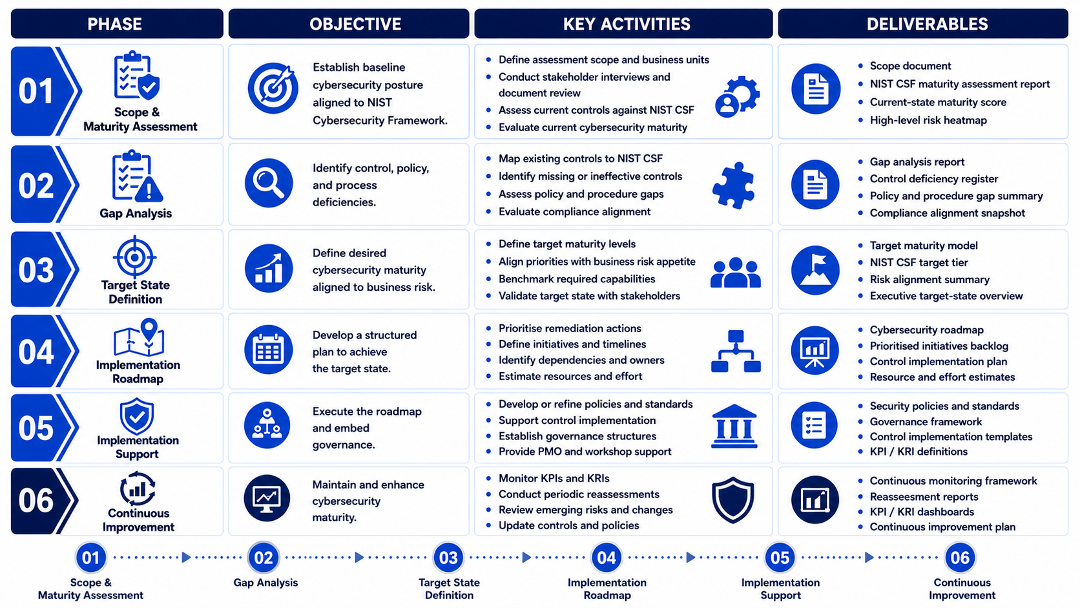
A structured NIST CSF Implementation programme should reflect the organisation’s existing cybersecurity maturity, risk profile, technology environment and business priorities. Kelmac Group® can support the process through current-state assessment, gap analysis, target-state definition, implementation planning and ongoing improvement activities. CSF 2.0 Organizational Profiles can be used to describe current and target cybersecurity outcomes and help identify gaps between them. Rather than applying the Framework as a fixed checklist, implementation priorities can be developed around identified risks, business requirements, available resources and the cybersecurity outcomes the organisation needs to achieve.
· Holistic Cyber Risk Management
· Address risks across people, processes, and technology.
· Scalable Framework
· Adaptable for organisations of all sizes and sectors.
· Improved Incident Response
· Enhance readiness and response capabilities.
· Integration with Other Standards
· Align with ISO 27001, CIS Controls, and regulatory frameworks.
· Better Decision-Making
· Provide leadership with clear visibility into cyber risk.
Adopting the NIST Cybersecurity Framework can give organisations a consistent basis for understanding, assessing, prioritising and communicating cybersecurity risk. CSF 2.0 places greater emphasis on governance and provides outcomes that can be applied across different technologies and operating environments. For organisations working across India and international markets, the NIST Cybersecurity Framework can also provide a recognised reference point for conversations with customers, management teams and other stakeholders. Its flexible structure allows organisations to integrate CSF outcomes with existing cybersecurity, risk-management and compliance activities without treating the Framework itself as a certification scheme.
Frequently Asked Questions
No, but it is widely adopted as best practice and often expected by regulators and partners.
There is no universal implementation period defined by NIST. The time required for NIST CSF Implementation depends on factors such as organisational size, scope, cybersecurity maturity, identified gaps, available resources, technology complexity and the target outcomes selected. Because CSF 2.0 is outcome-based rather than a prescribed implementation programme, organisations can prioritise activities according to their cybersecurity risks and business requirements. A NIST CSF 2.0 Assessment can help establish the current position and provide a more informed basis for defining an implementation roadmap.
Yes, both frameworks are complementary and can be integrated.
Yes, it is globally recognised and supports compliance with EU regulations.
Yes, we offer continuous advisory and maturity improvement services.
NIST CSF Implementation is the process of applying the Cybersecurity Framework to an organisation’s cybersecurity risk-management activities. Implementation may involve understanding the organisation’s current cybersecurity posture, establishing Current and Target Profiles, identifying gaps, prioritising improvements and monitoring progress. CSF 2.0 does not prescribe one implementation method or a universal set of controls. Instead, it defines cybersecurity outcomes that organisations can apply according to their risks, requirements, resources and operating environmen
A NIST CSF 2.0 Assessment examines an organisation’s cybersecurity practices against relevant outcomes within the Framework. It can help establish the current state, identify gaps and determine priorities for improvement across Govern, Identify, Protect, Detect, Respond and Recover. Organizational Profiles can support comparison between current and target cybersecurity outcomes, while CSF Tiers can provide context on the rigour of cybersecurity risk governance and management practices. The assessment should be tailored to the organisation rather than treated as a generic compliance checklist.
No. NIST CSF 2.0 provides guidance and cybersecurity outcomes that organisations can use to manage cybersecurity risk; it is not a certification standard. The Framework provides a taxonomy of high-level cybersecurity outcomes and does not prescribe how those outcomes must be achieved. Organisations can therefore use the Framework to assess and improve cybersecurity practices without pursuing a “NIST CSF certification.” Where certification or regulatory requirements also apply, these should be addressed separately according to the relevant standard or legislation.